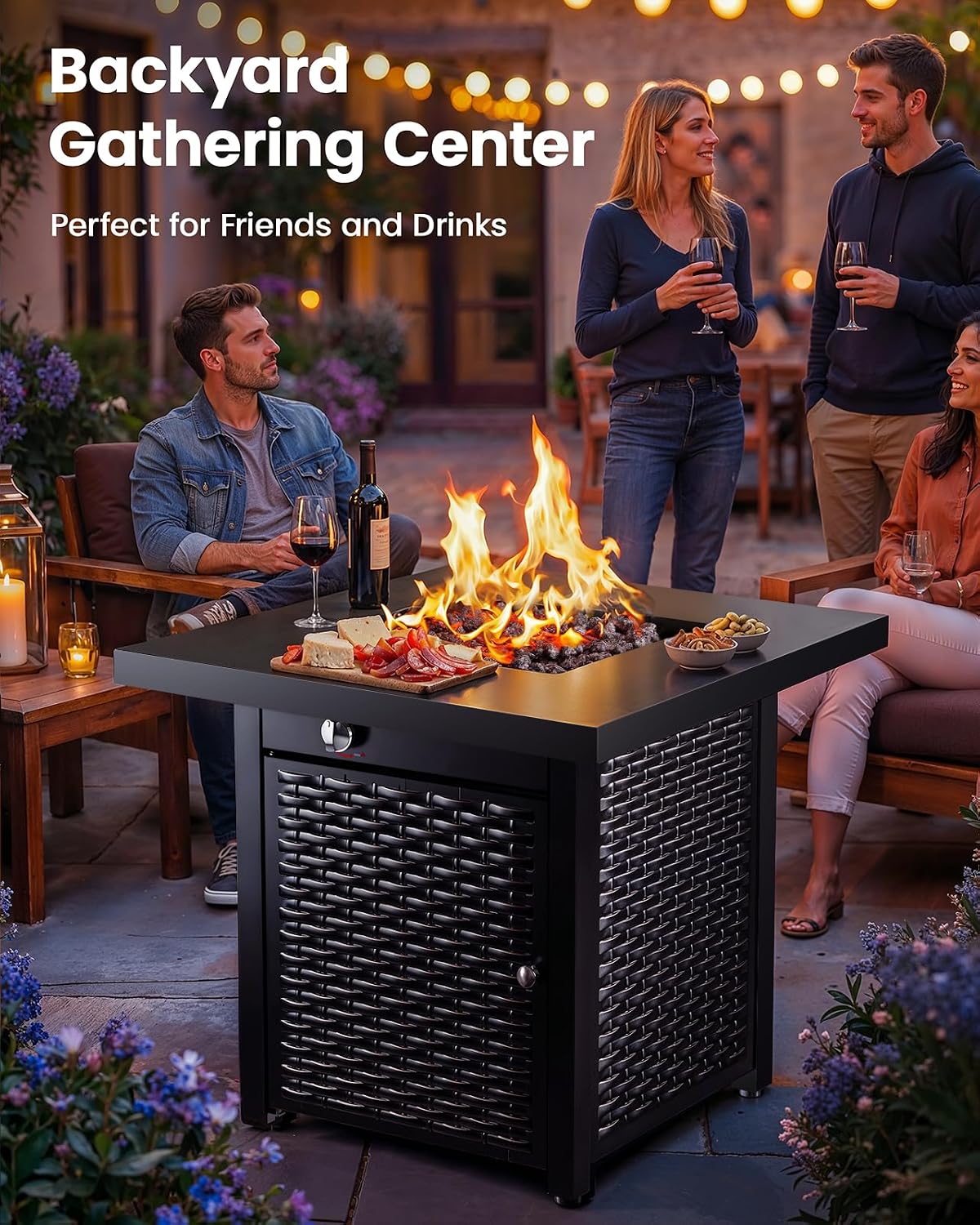
A propane fire pit table is exactly what it sounds like: a piece of outdoor furniture — usually a rectangular or round table — with a gas burner recessed into the center that produces a live flame over decorative fire glass or lava rock. You connect a standard propane tank (typically the same 20-pound cylinder used for a backyard grill), open the valve, and ignite. No wood, no ash, no waiting for embers to die. That simplicity is the whole pitch. But between a $300 unit from a big-box store and a $2,000 architectural-grade model from American Fyre Designs or Elementi, there is an enormous gap in material quality, heat performance, and how many seasons the thing actually survives. This guide names the specific numbers you need, explains where manufacturers fudge them, and ends with a clear decision rule for every budget.
| EDITOR'S PICKAurora Fire Table Outdoor Fire… | Mid-tier[Ciays 42-Inch Propane Fire Pit…](https://www.amazon.com/dp/B0CSCVSCMF?tag=greenflower20-20) | Budget pick[Ciays 28 Inch Propane Fire Pit…](https://www.amazon.com/dp/B09GXJTTDN?tag=greenflower20-20) | |
|---|---|---|---|
| BTU Output | 45,000 BTUs | 60,000 BTU | 50,000 BTU |
| Material | Cast Concrete | Steel | Steel |
| Dimensions | 34" x 34" | 42-Inch | 28 Inch |
| CSA-Listed | — | — | ✓ |
| Lid Included | — | ✓ | ✓ |
| Price | $999.00 | $220.82 | $154.95 |
| See on Amazon → | See on Amazon → | See on Amazon → |
BTU Claims Are Technically True and Practically Misleading
BTU — British Thermal Unit — is the standard measure of heat energy output. Manufacturers rate their burners by BTU per hour, and a quick scan of product listings will show you everything from 30,000 BTU to 65,000 BTU at similar price points. Here is the first trap: a high BTU rating does not automatically mean more warmth for the people sitting around the table.
Heat output at the burner and perceived warmth at seat height are two different things. A wide, shallow pan burner spreading 50,000 BTU across a 30-inch flame spread will warm more people more effectively than a narrow ring burner dumping 60,000 BTU upward in a tighter column. This Old House’s editorial guide on gas fire pit selection specifically notes that flame spread and burner geometry matter as much as raw BTU figures — a point most product listings quietly ignore.
The BTU math that actually matters:
| Price tier | Typical rated BTU | Realistic usable BTU at seat level | Common burner type |
|---|---|---|---|
| $300–$600 | 40,000–50,000 | ~55–65% | Single ring, stamped steel |
| $600–$1,200 | 50,000–60,000 | ~65–75% | Pan burner or dual-ring |
| $1,200–$2,000+ | 55,000–65,000 | ~75–85% | Brass/stainless ring or linear pan |
The efficiency range above is derived from published spec comparisons and aggregated owner reviews — not a lab measurement — but the pattern is consistent: premium burners in thicker housings retain and redirect more heat than thin stamped-steel units that lose energy to the frame itself.
What CSA certification actually tells you. Any unit sold in the U.S. or Canada should carry certification to ANSI Z21.97 / CSA 2.41, the standard for outdoor decorative gas appliances. This certification confirms the unit was tested for safe ignition, valve operation, and gas leak thresholds — it does not validate the BTU claim or flame performance. Per the CSA Group’s published standard documentation, the certification scope is safety, not efficiency. Knowing this prevents a common mistake: treating CSA/UL marking as a proxy for heat quality.
Material Longevity by Climate — This Is Where Budget Units Fail
The table frame and burner housing are where the real cost-of-ownership divergence shows up. Here is how the main materials stack up by climate exposure:
Powder-coated steel is the dominant material at the $400–$1,200 tier. Brands like BondHome and Hampton Bay use 14–16 gauge steel with polyester powder coat. The coating resists UV and mild moisture well for one to two seasons. The failure mode is edge chipping at weld seams — once bare steel is exposed in a coastal or high-humidity environment, surface rust propagates fast. Owners in coastal markets (per aggregated reviews on Hearth.com’s discussion forums) consistently report visible rust at weld points within 18–24 months without seasonal protective covers and touch-up paint.
Aluminum is lighter and inherently corrosion-resistant, which is why it dominates the mid-to-upper tier ($900–$1,800). Elementi uses cast aluminum with powder coat for its Lunar and Milano series. Aluminum does not rust; it oxidizes into a chalky patina that is cosmetically unappealing but structurally benign. The trade-off is dimensional stability under heat — cheap cast aluminum can warp near burner housings if wall thickness is under 3mm. Spec sheets from Elementi list 5–6mm casting thickness on their architectural-grade frames, which owners report holds dimensional form after multi-season use.
Corten steel (also called weathering steel) is increasingly appearing in premium fire pit table designs above $1,500. It develops a controlled rust patina that stabilizes after 12–18 months and then resists further corrosion. The real-world caveat that Family Handyman’s buying guide flags: corten runoff during the initial patination phase will stain concrete, light-colored pavers, and adjacent furniture. If your patio is light travertine or white concrete, plan for either a lag period before deployment or a sacrificial border around the unit.
Copper and cast iron appear occasionally at the high end. Cast iron is excellent for heat retention but is heavy (120–180 lbs for a table unit), requires annual seasoning or protective oil treatment, and develops surface rust in coastal climates unless specifically coated. Copper develops a distinctive green verdigris patina. Both materials carry strong aesthetic coherence with traditional hearth design; neither is low-maintenance.
The cover question is not optional. Regardless of material tier, every manufacturer including American Fyre Designs and Elementi recommends a fitted cover when the unit is not in use. Consumer Reports’ 2024–2025 reliability survey of outdoor gas appliances found that covered units showed significantly lower rates of burner corrosion and igniter failure across all price tiers — the single highest-impact maintenance action you can take.
Hidden Costs: What the Sticker Price Doesn’t Include
This is the section that changes the math on what you’re actually paying.
Propane consumption. A 50,000 BTU burner running at full output burns approximately 0.55 pounds of propane per hour. A standard 20-lb tank holds roughly 4.7 gallons of usable propane, yielding about 9–10 hours of full-burn runtime before refill. At May 2026 propane prices averaging $3.60–$4.20/gallon nationally (per U.S. Energy Information Administration propane residential price tracking), that’s roughly $17–$20 per tank fill. Run the fire three evenings a week at moderate throttle (say, 40% output), and you’re looking at $30–$50/month in fuel during active season. Over a five-year table lifespan, fuel cost outpaces the original purchase price at every tier.
The regulator and hose situation. Most tables ship with a low-pressure regulator set to 11 inches water column (the standard for propane appliances). Budget units sometimes ship with undersized hose diameters (3/8-inch ID vs. the recommended 1/2-inch ID for burners above 50,000 BTU), which restricts flow and reduces effective heat output below the rated figure. This is a solvable problem — aftermarket 1/2-inch ID high-pressure hose and regulator assemblies run $25–$45 — but it’s a hidden cost and performance variable that rarely appears in marketing copy.
Igniter replacement. The most common failure point across all price tiers, per Hearth.com owner discussions, is the piezo igniter. Inexpensive push-button igniters on budget units typically fail within two to three seasons in outdoor humidity. Replacement igniters run $10–$30 and are a DIY fix, but units with proprietary igniter housings (common in some integrated-table designs) can require manufacturer parts with lead times. When evaluating a unit, check whether the igniter is a standard push-button AA-battery electronic igniter or a proprietary component.
Cover and windscreen accessories. A properly fitted cover for a 48–60 inch rectangular fire pit table runs $40–$90 for mid-grade polyester canvas. Glass windscreen panels — tempered glass surrounds that reduce flame flutter in breezy conditions — add $80–$200 depending on unit. Neither is strictly required, but both materially extend service life and usability.
By the numbers — true 5-year cost of ownership:
| Scenario | Unit sticker | Cover + accessories | Fuel (5 seasons) | Maintenance/parts | 5-yr total |
|---|---|---|---|---|---|
| Budget ($400 steel) | $400 | $60 | $900 | $120 | ~$1,480 |
| Mid-range ($900 aluminum) | $900 | $90 | $900 | $60 | ~$1,950 |
| Premium ($1,800 cast aluminum) | $1,800 | $120 | $900 | $30 | ~$2,850 |
The fuel line is nearly identical across tiers — it’s a fixed operating cost. The premium unit’s advantage is in lower maintenance drag and longevity beyond five years; a well-maintained Elementi or American Fyre Designs unit carries documented service lives of 10–15 seasons per HPBA’s 2025 Outdoor Living Report on high-end outdoor gas appliance longevity trends.
Which Brands Actually Deliver — And Where Each One Stops
American Fyre Designs is the benchmark at the $1,500–$2,500 range. Their GFRC (glass fiber reinforced concrete) table tops are spec’d at 1.5–2 inch thickness, which resists cracking in freeze-thaw climates far better than the thin poured concrete used in cheaper units. Owners consistently report minimal degradation after four or more seasons in USDA hardiness zones 5–7. The trade-off: GFRC is heavy (some models exceed 200 lbs assembled), and the design language leans toward a contemporary architectural aesthetic that doesn’t suit every patio style.
Elementi delivers the strongest value-to-longevity ratio in the $900–$1,600 band. Their cast aluminum frames with integrated lava rock storage and modular fire glass options get consistent owner praise for build consistency out of the box. Published specs on their burner assemblies list stainless steel construction on the burner ring itself — a meaningful durability differentiator over plated steel at lower price points.
Esschert Design plays in the $400–$800 range with a focus on decorative aesthetic over pure heat engineering. Their units work well for mild-climate patios where ambiance drives the purchase more than warmth. Owners in colder climates (zones 5 and below) note the heat output feels insufficient for shoulder-season use — a consistent theme in aggregated reviews.
Budget/generic units ($300–$500) from mass-market channels are a defensible choice for renters, first-season experimenters, or climates with limited outdoor living windows. The performance ceiling is real — thin steel frames, undersized burners, and short igniter life — but the entry cost is low enough that replacement in three to four years is financially equivalent to buying a mid-tier unit and maintaining it.
The Decision Rule
If your patio is in a high-humidity or coastal climate, eliminate powder-coated steel entirely regardless of BTU claims — the corrosion math doesn’t work past two seasons without ongoing maintenance you likely won’t do. Go aluminum at minimum.
If you’re furnishing a permanent outdoor living space with hardscape investment above $3,000, the 5-year cost table above makes the $1,800 premium unit rational — you’re buying 15 years of service and avoiding the aesthetic mismatch of a budget unit against premium pavers.
If this is a seasonal-use patio in a freeze-free climate and aesthetics matter more than maximum heat, Elementi’s mid-range line is the call — aluminum longevity, reasonable BTU output, and design quality that holds up against premium furniture.
And whatever you buy: cover it, check the hose diameter against the burner rating, and budget $30–$50/month in fuel so the operating cost isn’t a surprise. The unit is not the whole cost. The unit is just the beginning.