A chimenea (chim-uh-NAY-uh) is a freestanding outdoor fireplace — picture a clay or metal pot with a short belly and a vertical chimney rising out of the top. You load wood or manufactured logs through a front opening, light a fire, and the chimney draws smoke up and away from your seating area. They’ve been a patio staple for decades because they’re self-contained, require no masonry work, and move if you rearrange your space. Most people start with a $60–$150 clay version from a big-box store — which works, until a hard freeze cracks it in year two. Cast iron is the step up: heavier, more durable, and significantly more expensive. At the top of that cast-iron tier sits the Blue Rooster Company’s Casita, a model that routinely prices between $1,000 and $1,400 depending on finish and retailer. This article is about whether that number makes sense — and what you’re actually buying for it.
What Separates a $150 Clay Chimenea from a $1,200 Cast-Iron One
The honest one-sentence answer: material physics and manufacturing tolerance. After that, nearly everything else follows.
Clay is kiln-fired earthenware. It insulates well, looks beautiful, and costs almost nothing to produce. Its fatal weakness is thermal shock — the rapid temperature change when rain hits a hot firebox, or when water trapped in microscopic pores expands during a freeze. This Old House’s outdoor fireplace buying guide explicitly flags freeze-thaw cycling as the primary failure mode for clay chimeneas in USDA Hardiness Zones 6 and colder, where overnight temps regularly dip below 0°F. Owners in the Pacific Northwest, the upper Midwest, and the Northeast routinely report cracked clay chimeneas after their first or second winter, even with covers.
Cast iron is a different category of material entirely. It’s a dense iron-carbon alloy, cast in molds and capable of reaching and holding heat at levels clay cannot sustain without cracking. A properly seasoned cast-iron firebox — “seasoning” here means building a slow first fire to cure the iron and let it expand and contract uniformly — will handle repeated high-heat cycles, rain, and freezing temperatures that would destroy a clay unit within a season or two. The tradeoff is weight (most full-size cast-iron chimeneas run 80–150 lbs) and price.
Within the cast-iron category, you also have a meaningful spread. Entry-level cast-iron chimeneas from import brands (typically $200–$400) use thinner-wall castings, rougher surface finishing, and hardware that owners on Hearth.com consistently flag as corroding or seizing within 2–3 seasons. Premium cast-iron units from Blue Rooster, Esschert Design, and American Fyre Designs use heavier wall sections, tighter machined fits between the bowl and chimney collar, and powder-coat or high-temp paint finishes baked on at the factory rather than brushed on post-casting.
By the numbers — Blue Rooster Casita vs. the cast-iron category:
| Model tier | Wall thickness (approx.) | Weight | Price range (2025–2026) | Typical warranty |
|---|---|---|---|---|
| Import cast-iron (unbranded) | ~4–6 mm | 50–70 lbs | $180–$380 | 90 days–1 year |
| Mid-tier (Esschert Design) | ~7–9 mm | 80–110 lbs | $400–$700 | 1–2 years |
| Blue Rooster Casita | ~10–12 mm | 112–135 lbs | $1,000–$1,400 | Lifetime (firebox) |
| American Fyre Designs cast-iron | ~10–14 mm | 120–160 lbs | $1,200–$2,200 | Lifetime (firebox) |
Wall thickness figures sourced from Blue Rooster published spec sheets and Esschert Design product data; import figures represent aggregated owner teardown observations from Hearth.com forum posts, 2022–2025.
The Blue Rooster Casita: What Reviewers and Owners Actually Report
The Casita is Blue Rooster’s flagship chimenea, offered in several finishes including their signature cobalt blue, slate black, and antique copper powder coat. The company markets it as a lifetime firebox — and the warranty language on their published spec sheets does cover the cast-iron firebox body against cracking or structural failure for the life of the original owner, with standard exclusions for improper use.
Owners on Hearth.com and aggregated by Bob Vila’s best chimeneas roundup consistently report three things that distinguish the Casita from cheaper cast-iron units:
-
Heat retention: The heavier wall section holds radiant heat noticeably longer than thin-wall imports. Owners report the exterior body staying warm to the touch for 45–90 minutes after a fire dies down — useful on cool evenings when you want the fire to wind down naturally rather than rebuild it.
-
Draw performance: The chimney-to-bowl proportion on the Casita is engineered for consistent draft. Multiple long-term owners note that smoke routing is reliable even in moderate crosswind, which is often a complaint on narrower-chimney import units.
-
Hardware durability: The door hinges, damper rod (if equipped), and chimney cap hardware show up consistently in positive reviews as still functional after 5–8 seasons. The HPBA’s 2024 outdoor hearth products market report notes that hardware failure — specifically hinge corrosion and chimney cap warping — is the most cited dissatisfier among owners of sub-$500 cast-iron chimeneas.
The honest counterpoints: the Casita is heavy enough that solo relocation is difficult, which matters if you seasonally store it. And the powder-coat finish, while durable, will eventually chip in high-use areas (around the door opening and base ring) — a touch-up with high-temp paint is owner-manageable but is a maintenance task that owners of corten or raw cast units don’t face in the same way.
The Pizza Oven Question: Can Premium Cast-Iron Chimeneas Actually Bake?
The slug for this article references pizza ovens, and it’s worth addressing directly because it’s a real decision fork for a segment of buyers.
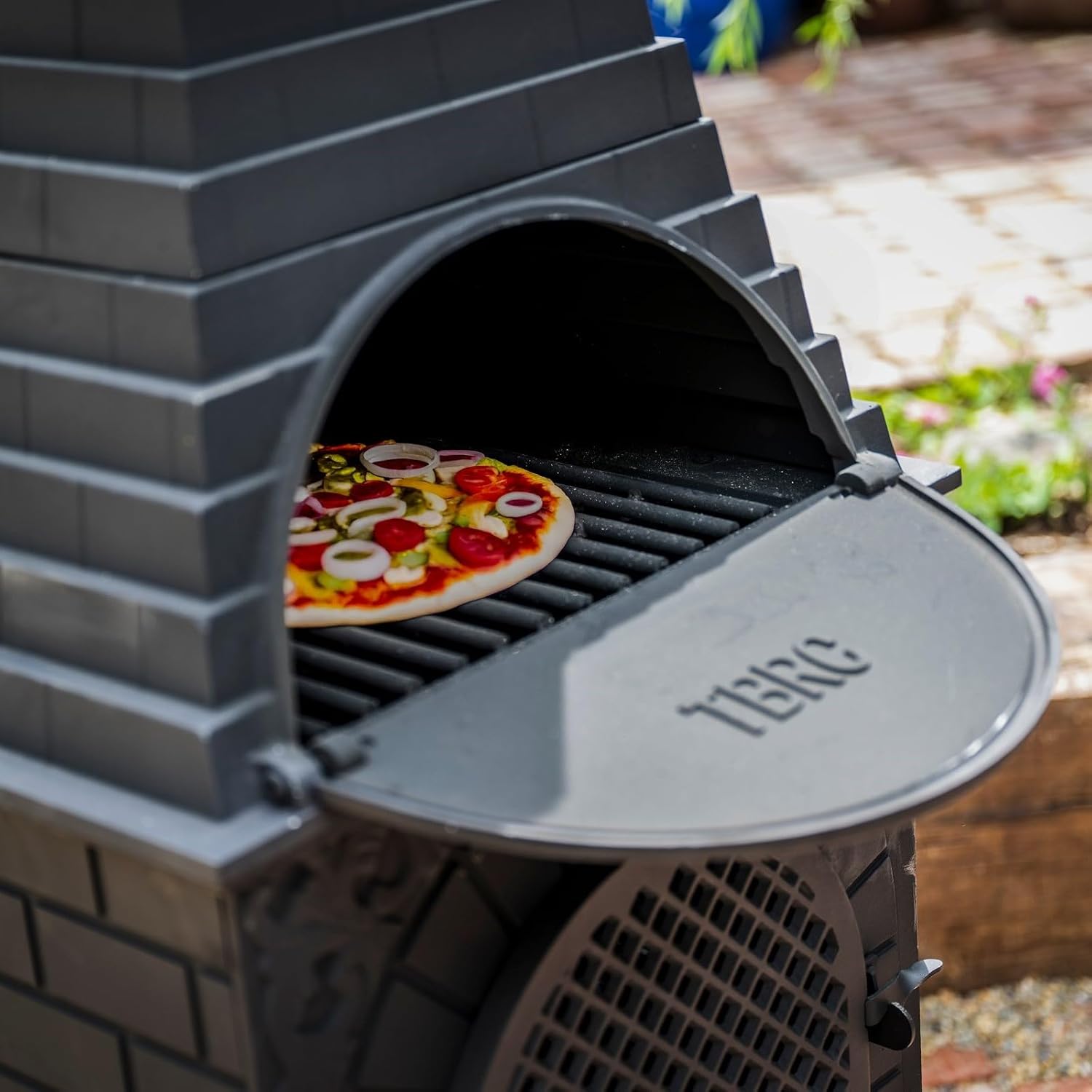
Some Blue Rooster models — notably the Davinci and the Tall Boy — include a cast-iron grate system and an enclosed belly geometry that, per manufacturer specs, can reach internal temperatures of 500–700°F with a sustained hardwood fire. Blue Rooster markets these as dual-function units: fire feature and outdoor oven. Owners have documented baking flatbreads, roasting vegetables, and cooking cast-iron skillet meals in them.
The honest assessment from aggregated owner reports: they work as rudimentary outdoor ovens, but they are not pizza ovens in any technical sense. A dedicated wood-fired pizza oven (masonry or prefab refractory) maintains more even heat distribution, stores more thermal mass, and reaches dome temperatures of 700–900°F more reliably. The Blue Rooster’s enclosed belly reaches cooking temps, but temperature consistency is more variable and dependent on fire management skill.
If your project has a pizza oven line item, a standalone wood-fired pizza oven from brands like Alfa, Ooni (propane models excluded), or a prefab masonry kit will perform better as a cooking appliance. Where the Blue Rooster Davinci or similar dual-use cast-iron chimenea makes sense is when budget, space, or HOA restrictions mean you need a single multipurpose unit — and you’re willing to accept “occasional outdoor cooking” rather than “dedicated pizza oven performance.”
This Old House’s outdoor fireplace buying guide draws a similar distinction, noting that combination fire-and-cook units offer versatility but typically sacrifice depth in either function compared to purpose-built products.
Clearances, Codes, and Where This Gets Real
This is where practitioners need to slow down. A freestanding chimenea — even a premium cast-iron unit — is still a portable solid-fuel appliance, and most jurisdictions treat it differently than a permanent outdoor fireplace. That said, there are clearance minimums that matter regardless of code status.
What NFPA 211 and general fire safety guidance say (per This Old House and HPBA documentation):
- Minimum 10 feet clearance from combustible structures (wood siding, composite decking, vinyl fencing, pergola rafters) in all directions
- Minimum 3 feet of non-combustible surface under the firebox (pavers, concrete, flagstone — not wood decking without a non-combustible heat pad)
- Covered patio / pergola use: the 10-foot clearance rule often cannot be met under a standard pergola, and open-top pergolas with combustible rafters overhead are a documented ignition risk from upward sparks. Blue Rooster’s own product documentation advises against use under combustible overhead structures.
Local air quality districts in California (SCAQMD, BAAQMD) and several Colorado Front Range jurisdictions have episodic burn bans and, in some cases, permanent restrictions on wood-burning appliances in certain zones. The HPBA’s 2024 market report flags this as a growing constraint on wood-burning outdoor hearth product sales in the Western US — and it’s relevant to any client or project in those regions. If you’re specifying a premium cast-iron chimenea for a California client, the burn-day question is a real conversation to have before the purchase order is signed.
The homeowner association layer is outside any published code but practically relevant: many HOAs prohibit open-flame wood-burning appliances regardless of material or price point. Confirming with the HOA CC&Rs before recommending a $1,200 product is basic due diligence.
The Decision Framework: If X, Then Y
Here’s the decision tree as clearly as the evidence supports:
If you’re in USDA Zone 6 or colder and want to keep the unit year-round outdoors → cast iron is the only category worth considering. Clay will crack. The question is which cast-iron tier. If budget allows, the Blue Rooster Casita’s lifetime warranty and owner-reported hardware durability make the premium defensible over a 10+ year horizon.
If you’re in a mild climate (Zone 8+, no hard freezes) and primarily care about aesthetics → a quality clay chimenea with diligent covering and end-of-season storage can genuinely last. You’re paying $150–$350 for a result that may last 5–8 years with care, versus $1,000–$1,400 for the cast-iron version that may last 20+. The math on cost-per-year starts to favor cast iron at roughly the 7–10 year mark.
If the project has a cooking use case → decide first whether cooking is a primary or secondary goal. Primary: budget for a dedicated wood-fired oven and a separate fire feature. Secondary / occasional: the Blue Rooster Davinci or a comparable dual-use unit covers it without requiring two footprints and two budgets.
If the install is on a covered patio or pergola → this is not a chimenea project until clearances are confirmed. A 10-foot horizontal clearance from combustibles is a hard floor. Many covered patios cannot meet it. The conversation shifts to a wall-mounted or built-in vented outdoor fireplace using a listed flue system (DuraVent DVL or similar) rather than a freestanding chimenea.
If the client is in a California air district or Colorado Front Range jurisdiction with burn restrictions → verify burn-day rules and year-round wood-burning restrictions before any product is specified. A premium cast-iron chimenea that can’t legally be used six months of the year is a hard sell.
The $1,000+ price tag on a Blue Rooster Casita is justified when the conditions that destroy cheaper products — freeze-thaw cycling, high-frequency use, multi-season outdoor exposure — are actually present in your project. It’s less justified when those conditions aren’t there and a more modest unit would genuinely serve the use case. That’s the honest answer, and it’s the one worth giving your client or yourself before signing the order.
Clearance distances and code applicability vary by jurisdiction. Always confirm local fire code and air quality regulations with your local authority having jurisdiction (AHJ) before installation. This article reflects research and published specifications current as of May 2026.