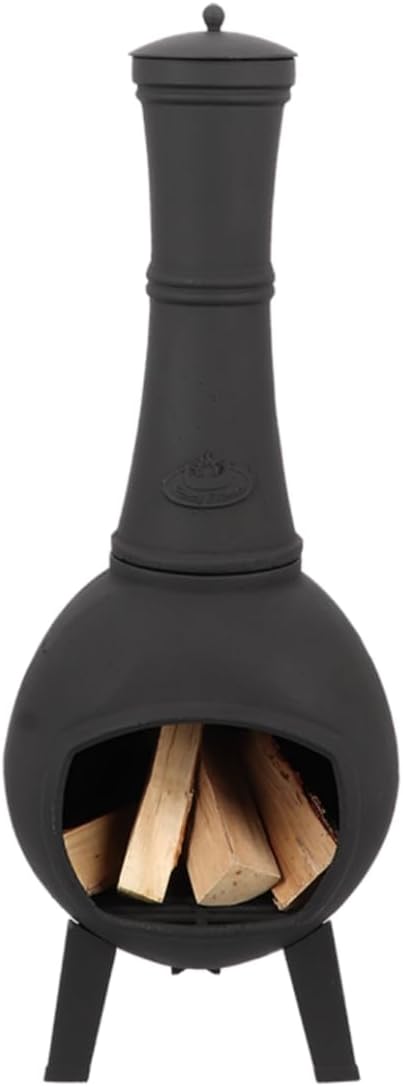
If you’ve been shopping for a chimenea — a freestanding outdoor fireplace shaped like a bulbous pot with a tall chimney neck — you’ve almost certainly landed on Esschert Design somewhere in your search. The Dutch company has been manufacturing terra cotta (fired clay) garden products since 1990, and their “Terra Heater” line is probably the most-cited European chimenea brand among North American patio enthusiasts. Terra cotta, for context, is the same dense, kiln-fired clay you’d recognize from classic garden pots — warm reddish-orange, naturally porous, and capable of holding and radiating significant heat. Esschert positions its Terra Heaters as a step above the anonymous $60 import chimeneas that crowd big-box stores, with genuine Dutch artisan heritage and clay sourced from European deposits. Whether that story is worth the $180–$350 retail premium over comparable mass-market units is exactly the question this article answers. We’ll go through material specs, climate fit, sizing math, and the honest trade-off frame so you can close the decision.
What Esschert Design Actually Makes (and Why the Distinction Matters)
Esschert Design is a garden-product manufacturer and importer headquartered in the Netherlands, best known outside Europe for their cast-iron and terra cotta fire products. The “Terra Heater” line — the focus here — is their fired clay chimenea range, distinct from their smaller cast-iron and corten steel pieces. As of May 2026, the Terra Heater series spans roughly four configurations:
- Small Terra Heater (~25” total height): patio-accent scale, suited for one-to-two person seating.
- Medium Terra Heater (~35” total height): the most widely reviewed configuration, appropriate for 3–4 person gatherings.
- Large Terra Heater (~45” total height): the architectural anchor piece, competitive with full-size cast iron at similar price points.
- Tall Neck / Elongated variants: specialized for additional draw (the chimney draft that pulls combustion gases upward and away from users).
Retail pricing as tracked through authorized distributors in spring 2026 puts the medium unit at approximately $185–$230 and the large at $270–$350 depending on the reseller margin and whether the unit is shipping direct from a Netherlands warehouse or through U.S. distribution. That sits above the Home Depot / Walmart clay chimenea tier ($60–$130) and below serious cast-iron and powder-coated steel units from American Fyre Designs or Elementi ($500–$1,800).
This is a meaningful pricing gap to understand, because the competition at the $200–$350 band is crowded — you’re not just comparing Esschert against cheap imports; you’re comparing them against entry-level cast iron (which doesn’t crack) and mid-tier painted steel (which heats faster). The decision isn’t “good vs. bad.” It’s a material philosophy choice.
Material Science: What Clay Gets Right and Where It Fails
This is the core of the practitioner decision. Terra cotta’s properties are well-documented in ceramic engineering literature, and they create a very specific performance envelope.
What clay does well: Terra cotta has genuinely good thermal mass — it absorbs heat slowly and releases it slowly, which means a clay chimenea that’s been burning for 45 minutes continues radiating warmth after the fire dies down. Owners on Hearth.com’s chimenea forums consistently describe this as the “campfire wind-down” quality they can’t replicate with steel. Clay also produces a radiant heat signature that feels warmer at the same measured BTU output because it’s emitting longer infrared wavelengths compared to a steel shell. This is physics, not marketing — confirmed in the HPBA’s 2024 outdoor heating category report, which notes clay and masonry products rate higher on perceived warmth in user surveys than equivalent-BTU metal units.
Where clay creates real operational risk: Thermal shock. This is the number one failure mode for terra cotta chimeneas — not just Esschert’s, but any clay unit. Thermal shock occurs when cold water (rain, condensation, an overzealous cleaning) contacts a hot clay surface and causes localized expansion stress. The clay cracks. Bob Vila’s chimenea buying guide (2024) flags this directly, noting that clay chimeneas should be covered when not in use and that owners in wet climates consistently report shorter service lives without covers.
Freeze-thaw is the critical climate variable. Terra cotta is porous — it absorbs moisture. In freeze-thaw climates (USDA Hardiness Zones 6 and colder, or anywhere with overnight sub-freezing temperatures from November through March), absorbed moisture expands when it freezes and mechanically fractures clay from the inside. This is why European terra cotta products frequently specify “frost-resistant” or “frost-proof” in their literature — and it’s worth reading Esschert’s spec sheets carefully, because “frost-resistant” (rated to a certain number of freeze-thaw cycles) is meaningfully different from “frost-proof.” Esschert’s published documentation describes their Terra Heaters as manufactured from high-fired clay but does not claim frost-proof certification in the way that vitrified ceramic garden products sometimes do. If you’re in Minnesota, Vermont, or the Canadian provinces, that’s the read.
By the Numbers — Climate Decision Frame:
| Climate Zone | Freeze-Thaw Risk | Recommended Action |
|---|---|---|
| USDA Zones 8–10 (Coastal CA, Gulf, Pacific NW) | Low | Outdoors year-round with cover; clay optimal |
| USDA Zones 6–7 (Mid-Atlantic, PNW inland, Midwest mild) | Moderate | Seasonal indoor storage or insulated cover mandatory |
| USDA Zones 3–5 (Upper Midwest, New England, Mountain) | High | Consider cast iron; clay storage difficult at this scale |
Esschert vs. the Competition: Where the Premium Goes
This is the trade-off frame that most buyers need explicit help with. Let’s put three real options at the $150–$350 band in direct comparison, based on published specifications and aggregated owner reviews.
Option A: Esschert Design Large Terra Heater (~$300–$350)
- Material: European high-fired terra cotta
- Weight: ~35–40 lbs (manageable solo)
- Heat character: High thermal mass, slow radiant output
- Aesthetic: Traditional hand-formed profile, warm clay color, European provenance
- Risk profile: Thermal shock, freeze-thaw if not stored
- Service life (owner-reported, Hearth.com forums): 4–10 years with proper care; 1–3 years without covers in wet climates
Option B: Generic/House-Brand Cast Iron Chimenea (~$200–$280)
- Material: Cast iron, typically painted
- Weight: 50–70 lbs (harder to reposition)
- Heat character: Faster heat-up, less thermal mass, metal radiant output
- Aesthetic: Industrial-utilitarian; coastal rust risk without maintenance
- Risk profile: Paint degradation, rust at joints in humid/coastal environments
- Service life: 8–20 years with touch-up painting; faster degradation in coastal salt air without specific coating
Option C: Basic Import Clay Chimenea (~$65–$130, Home Depot / Walmart tier)
- Material: Lower-fired clay, often thinner walls
- Weight: ~20–30 lbs
- Heat character: Moderate thermal mass, thinner wall means less heat retention
- Aesthetic: Similar silhouette; less precise finishing
- Risk profile: Same thermal shock and freeze-thaw risks, but at lower initial cost to replace
- Service life (owner-reported): 1–5 years; replacement cost is lower but cumulative cost can exceed Esschert over 10 years
This Old House’s 2025 chimenea buying guide draws the same basic conclusion: the value proposition for a mid-tier European clay product like Esschert holds if you’re in a mild climate and plan to care for the unit properly. The math breaks down in freeze-thaw zones.
Sizing, Siting, and Setup: The Details That Determine Whether You’re Happy
Sizing rule of thumb: Esschert’s published firebox dimensions on the large unit accommodate logs up to approximately 16 inches — standard cordwood half-length. The medium unit runs about 12-inch capacity. If you’re burning full-length store-bought firewood without splitting, the medium will frustrate you. Size up or commit to splitting.
Clearances: Because chimeneas are freestanding and not UL 127-listed (that listing framework applies to built-in fireplace systems), local code clearance requirements vary significantly. Sunset Magazine’s 2024 fire feature guide notes that most jurisdictions default to 10 feet of clearance from combustibles for freestanding clay or metal chimeneas, but covered patios, pergolas with combustible roofing, and HOA-governed communities can impose stricter or different rules. Check with your local fire marshal or building department — this is the one piece of this article where I’ll explicitly say we can’t give you the authoritative local answer. A $300 chimenea shouldn’t generate a fire code violation or a homeowner’s insurance claim.
Surface: Place on non-combustible surfaces — concrete, brick, stone pavers. Terra cotta chimeneas run hot at the base during extended fires; composite decking is a documented problem. Esschert’s product documentation recommends a metal stand (sold separately or included depending on configuration) that elevates the unit and allows airflow beneath.
Curing the clay: New terra cotta chimeneas require a break-in sequence of progressively larger fires — typically three to five sessions, starting with a small kindling fire and working toward full-load fires over successive days. This is industry-standard practice across all clay chimenea manufacturers; skipping it is the most common cause of early cracking. Bob Vila’s buying guide covers this in detail.
The Honest Verdict: If X, Then Y
Esschert Design’s Terra Heater is a genuinely well-regarded product in its category. Across aggregated owner reviews and forum discussions, the pattern is consistent: buyers who live in mild climates, store or cover the unit diligently, and cure it properly report years of strong performance and consider the premium justified. Buyers who leave it uncovered in wet winters or expect cast-iron durability from a clay product are disappointed.
Here’s the decision rule, stated plainly:
If you’re in USDA Zone 7 or warmer, have covered or easily-storable outdoor space, and value radiant heat warmth and traditional clay aesthetics over durability guarantees → the Esschert large or medium Terra Heater is a sound buy at $230–$350. The European provenance and higher-fired clay quality are real differentiators over the $80 import tier.
If you’re in Zone 6 or colder, have no dry winter storage, or need a true set-it-and-forget-it product → spend the extra $150–$250 and get cast iron. The material physics don’t negotiate with your winters.
If you’re a landscape architect or outdoor kitchen designer specifying for a client → terra cotta belongs in the accent/seasonal category, not the architectural anchor category. For a covered outdoor living space where a fire feature is a year-round design element, Esschert’s cast-iron and corten products (or Elementi and American Fyre Designs at higher price points) are a better specification conversation.
The European standard Esschert represents is real. Whether it’s worth the premium is, as always, a function of where you live and how you plan to live with it.