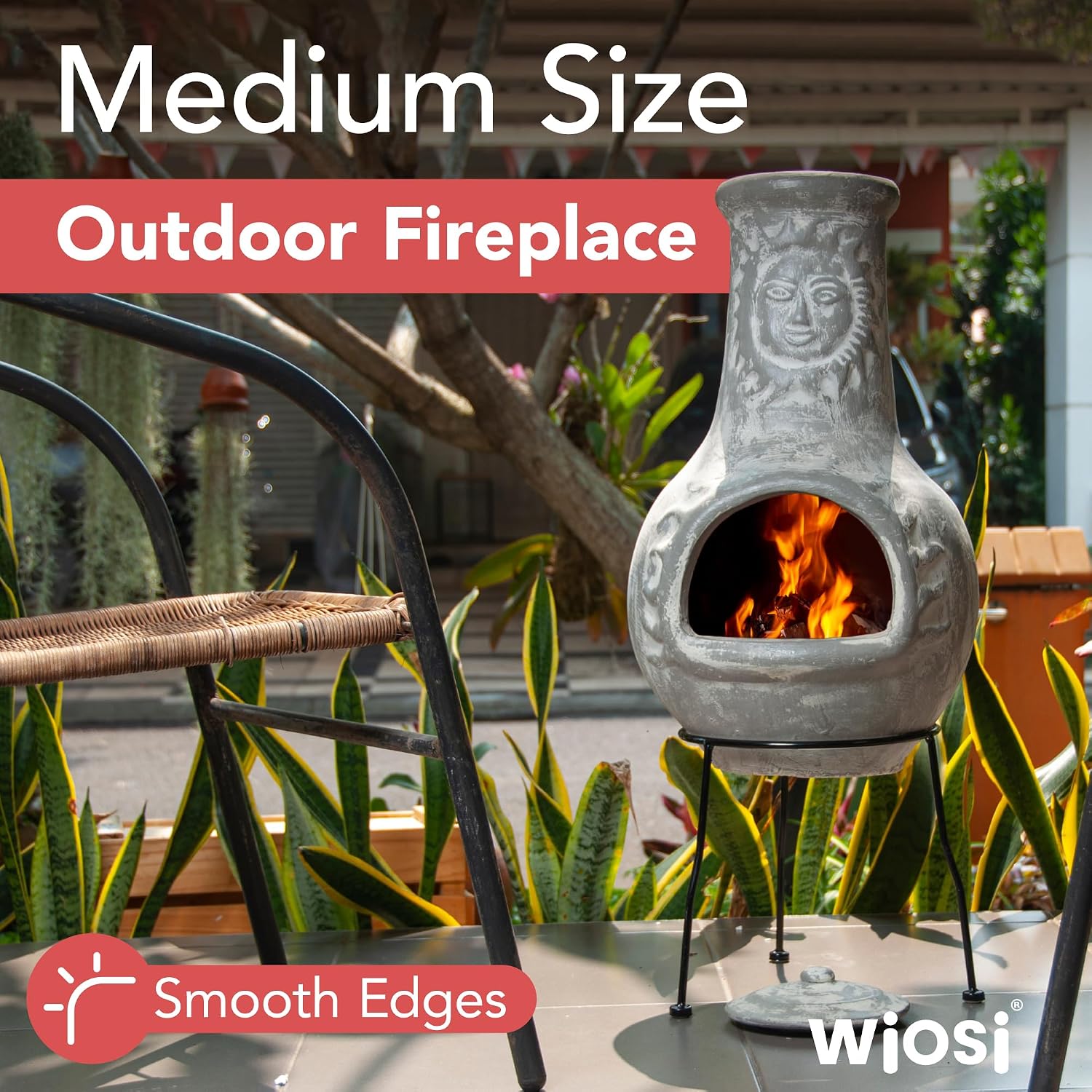
A clay chimenea — that round-bellied, front-opening fire pot with the narrow chimney neck — is one of the most inviting things you can put on a patio. They’re affordable, they radiate heat in an almost campfire-warm way, and a well-made one looks like it belongs on a Oaxacan courtyard. The catch: clay is a porous material, which means it absorbs water. When that water-soaked clay sits through a hard freeze, the water expands as it turns to ice — about nine percent by volume — and that expansion tries to blow the clay apart from the inside. That process, repeated across dozens of freeze-thaw cycles over a single winter, is how a $120 chimenea turns into a pile of shards by March. This guide explains how that failure actually happens, what the spec sheets tell you (and what they don’t), and how to make the right call before you hand over your card.
Why Clay and Freezing Temperatures Are a Dangerous Combination
The physics here is simple and unforgiving. Clay — whether earthenware, terracotta, or a “fired ceramic” blend — is full of microscopic pores. When rain, dew, or high humidity saturates those pores and temperatures drop below 32°F (0°C), the trapped moisture freezes. Ice occupies roughly nine percent more volume than liquid water, per the Portland Cement Association’s documentation on freeze-thaw resistance in ceramic and concrete materials. That expansion stress has nowhere to go except into the clay body itself, initiating hairline cracks. Each subsequent cycle widens those cracks. After enough cycles, you get spalling (surface flaking), deep fractures, or full structural failure.
The rate of damage depends on two variables: porosity (how much water the clay body can absorb) and freeze-thaw cycle count (how many times temperatures cross the 32°F threshold in a season). A high-porosity, low-fire terracotta chimenea in Portland, Oregon — where the temperature yo-yos across freezing dozens of times per winter — faces an entirely different risk profile than the same piece in Austin, Texas, where hard freezes are rare and short. This is why “outdoor-rated” labeling on a chimenea box is nearly meaningless without knowing the test standard behind that claim.
ASTM International’s Standard C1026, which covers freeze-thaw resistance of ceramic tile, uses 15 full thermal cycles as its baseline test. Some clay chimenea manufacturers reference comparable testing; most do not. When you see no test standard cited, assume the rating is marketing language rather than engineering documentation.
How to Read a Chimenea’s Material Specs for Cold-Climate Suitability
Not all clay is created equal, and the terminology on product pages tends to obscure more than it reveals. Here’s how to decode it.
Firing temperature matters most. Clay fired at higher temperatures (above roughly 2,000°F / 1,093°C) vitrifies — the silica in the clay body melts partially and fuses, closing off pores. A vitrified or semi-vitrified body absorbs far less water than a low-fire terracotta. Low-fire earthenware typically has water absorption rates of 10–15 percent by weight; high-fire stoneware or semi-vitrified bodies drop that to under 3 percent. The Fine Homebuilding outdoor fireplace buyer’s guide reinforces this: for any masonry or ceramic outdoor product in a freeze-prone climate, water absorption below 3 percent is the threshold to target.
“Handcrafted” and “artisan” are not cold-climate indicators. Many beautiful Mexican-made clay chimeneas are hand-thrown and low-fired — gorgeous, but genuinely unsuited for USDA Plant Hardiness Zones 6 and colder (average annual minimum temperatures below -10°F / -23°C, or more practically, regions where you’ll see more than 20–30 hard freeze nights per season).
Thickness is a partial hedge, not a solution. A thicker clay wall takes longer to saturate fully and provides more structural mass to resist crack propagation. But thickness doesn’t seal pores — it just slows the damage. Owners of thicker-walled Mexican clay chimeneas in cold climates consistently report the same eventual cracking; it just takes two or three seasons instead of one.
Sealed vs. unsealed bodies. Some manufacturers apply a sealant at the factory; others recommend you seal the piece after purchase. A penetrating masonry sealer — silane/siloxane formulations are the standard recommendation per This Old House’s guidance on winterizing outdoor masonry — reduces water ingress significantly but doesn’t eliminate it, especially as the sealant degrades over UV and heat exposure. Reapplication every one to two seasons is realistic maintenance for any clay chimenea used in a wet or cold climate.
By the Numbers: Climate Zones and Clay Risk
| USDA Zone | Avg. Winter Low | Freeze Nights/Season (est.) | Clay Chimenea Risk |
|---|---|---|---|
| Zone 9–10 (Phoenix, Miami) | 20–30°F | 0–5 | Low |
| Zone 7–8 (Atlanta, Seattle) | 0–20°F | 10–30 | Moderate — seal + store |
| Zone 5–6 (Chicago, Denver) | -20–0°F | 40–80 | High — store required |
| Zone 3–4 (Minneapolis, Buffalo) | Below -20°F | 80–120+ | Very high — clay not recommended |
Freeze night estimates are general seasonal averages; local microclimates and covered patio conditions vary.
The Real Decision Frame: Clay, Cast Iron, or Corten?
If you’re in Zone 7 or warmer and you’re willing to do the work of seasonal storage or weatherproofing, a quality clay chimenea remains a defensible buy. The Hearth, Patio & Barbecue Association’s consumer guide for outdoor hearth products notes that clay chimeneas continue to represent the entry-level volume segment of the outdoor hearth market precisely because the price-to-aesthetic value ratio is compelling when the climate allows it. The decision gets harder — and the math shifts — as you move into colder zones or if covered/year-round storage isn’t realistic.
If X = Zone 7 or warmer AND you have a dry, covered storage option for winter: A mid-grade clay chimenea in the $80–$150 range from a supplier who can confirm higher-fire construction and provides or recommends a sealer is a reasonable buy. Apply a silane/siloxane sealer before first use, drain and cover after every rain, and move it into a garage or shed before your first hard freeze. Realistically, expect a five-to-eight year lifespan with that care protocol — well above the per-season cost threshold for the aesthetic return.
If X = Zone 5–6 OR storage is unreliable: Cast iron becomes the correct comparison. A cast-iron chimenea from a brand like Esschert Design (typical street price: $250–$450 depending on size and finish) is essentially impervious to freeze-thaw cycling. Cast iron doesn’t absorb water; it rusts at the surface if the finish is compromised, but that’s a manageable maintenance issue versus the structural failure risk of clay. The tradeoff is weight (50–80 lbs versus 20–40 lbs for a comparable clay piece), higher upfront cost, and a different aesthetic — more industrial, less artisan. Owners of cast-iron chimeneas in cold-climate reviews consistently cite the durability as worth the price premium once they’ve replaced one or two clay units.
If X = Zone 3–4 or a coastal environment with both freezing temps and salt air: Corten steel (weathering steel that forms a stable rust-patina surface layer) is worth serious consideration, though most corten chimeneas sit in the $600–$1,200 range. Corten handles freeze-thaw without concern and develops a visually compelling patina, but the patina runoff will stain concrete and light-colored pavers — a real installation constraint. Cast iron at the coast risks accelerated rust unless the finish is maintained; corten’s self-passivating patina is more forgiving. Neither material is “maintenance-free,” but both are fundamentally better cold-climate choices than clay.
Storage and Winterization: What “Just Cover It” Actually Means
A standard patio furniture cover is not sufficient protection for a clay chimenea through a cold-weather season. The cover keeps direct rain off but doesn’t prevent condensation, humidity absorption, or the temperature cycling that drives freeze-thaw damage. If you’re going the clay route in a marginal climate, here’s what the protection protocol actually involves:
- End-of-season cleaning. Remove ash fully — ash is hygroscopic (it pulls moisture from the air) and will hold water against the clay interior.
- Sealant inspection and reapplication. Check the exterior for any chalking or loss of water beading. Reapply silane/siloxane sealer if needed and allow full cure time before storage.
- Indoor or fully enclosed storage. A garage, shed, or basement — somewhere that stays above freezing and doesn’t experience dramatic humidity swings. An unheated shed in Zone 5 may still see sub-freezing temps on extreme nights; true indoor storage is better.
- Elevation during storage. Keep the chimenea off a concrete floor on wood blocks or a mat — concrete wicks moisture upward.
This Old House’s guidance on winterizing outdoor masonry makes the broader point that no sealant fully substitutes for removing a porous ceramic product from freeze exposure. Treat the sealant as insurance for the rain-season shoulder period, not as a full winter-protection strategy.
One Trade-off Worth Naming Explicitly
There’s a version of this purchase decision that doesn’t get discussed enough: the end-of-season timing advantage. Clay chimeneas see their deepest retail discounts in late August through October — typically 25–40 percent off peak spring pricing, based on seasonal price patterns across outdoor living retailers. That’s the window when clay is genuinely attractively priced relative to cast iron. But it’s also the window when buyers in Zones 5–6 need to be most disciplined: buying a $70 clay chimenea on a September clearance sale and then not having a storage plan is how a good deal becomes a March write-off. If your storage situation is uncertain, buy cast iron in the clearance window instead — the discount pattern is similar, and the risk profile is categorically different.
The Bottom Line
Clay chimeneas are not inherently bad products — they’re climate-specific products sold as if climate doesn’t matter. The decision rule is straightforward: if your climate delivers more than 20–30 hard freeze nights per season, or if you won’t realistically store the piece indoors every winter, the math does not favor clay. Pay the premium for cast iron or corten and redirect the energy you’d spend on winterization toward actually using the fire. If you’re in a mild climate with a real storage plan, a well-constructed, higher-fire clay chimenea sealed properly is still one of the most appealing patio anchors at its price point — just go in knowing the maintenance commitment is the real cost of ownership.